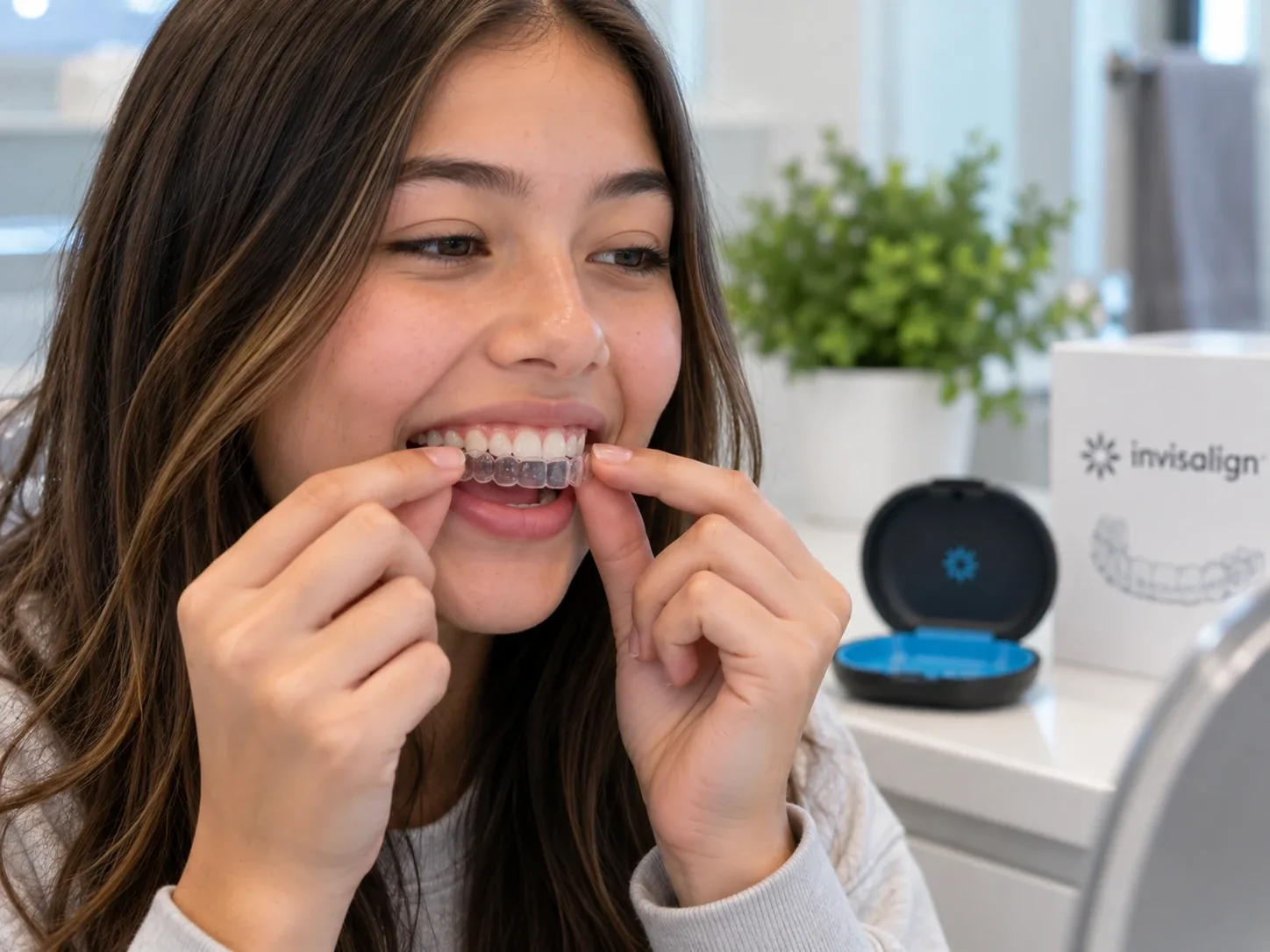
Clear aligners move teeth with a series of trays, each printed a fraction of a millimetre ahead of where your teeth are, worn 20–22 hours a day for one to two weeks apiece. For crowding, spacing and mild-to-moderate bite issues the results rival braces. The catch is the wear-time, and we say so at the first visit.
Why experience matters more here than with braces
Align manufactures the trays; the treatment plan is the orthodontist's. Where attachments go, how movements are staged, when to add elastics, how many refinement rounds to expect — those decisions are made in the digital setup before the first tray is printed, and they are learned through volume. Our practice holds Sapphire-tier provider status, a case-volume tier reached by roughly the top half-percent of Invisalign providers worldwide. We mention it not as a badge but because in aligner treatment it is the variable that most predicts your outcome after your own wear-time.
The honest limits
Severe rotations of round teeth, large bite corrections, big vertical movements and extraction-space closure remain harder for plastic than for wire. Sometimes the answer is a hybrid — a short phase in braces to do the hard movements, then aligners to finish. Sometimes the answer is braces. We'd rather tell you that at a free consultation than discover it after three refinement rounds — and when we do fit aligners, refinements and your retainers are included in the fee. What Invisalign can't fix is the frank version.
A closer look: the three things that decide an aligner outcome
First, case selection — whether the movements your teeth need are ones plastic makes predictably. Crowding, spacing and mild-to-moderate bite issues, yes; severe rotations, large bite corrections and extraction spaces, less so, and we say which yours is on the scan. Second, the plan — the manufacturer prints trays from the orthodontist's design, and the design decisions (attachment placement, staging, over-correction, elastics) are learned through volume; our Sapphire-tier status reflects that volume. Third, wear time — twenty to twenty-two hours a day, the one variable that's entirely yours. Get all three right and aligner results rival braces. Miss one and the case stalls.
What an Invisalign treatment at our practice includes
Records and the digital plan you see before committing. Attachments and any elastics or IPR the plan calls for. Every aligner including refinement rounds — most real cases need one, and ours are inside the fee. Monitoring checks every six to ten weeks, short enough to fit a lunch hour. Your retainers at the end, and retention checks through the first year. The package the case actually requires, named on the quote — limited or comprehensive — not the smallest one that wins the consultation.
Frequently asked questions about Invisalign in Coquitlam
How much does Invisalign cost in Coquitlam?
$4,500–$8,500 at our practice depending on the package the case needs, with refinements and retainers included. Details.
How long does Invisalign take?
Six to nine months for limited cases; twelve to eighteen for most comprehensive; longer for real bite correction.
Can Invisalign fix an overbite or crowding?
Mild-to-moderate versions of both, well. Where the line is.
Is Invisalign good for teenagers?
For the teenager who'll wear it, excellent. The honest guide.
Does Invisalign work for children?
Invisalign First handles early treatment for suitable six-to-ten-year-olds. Explained.
Can you eat with Invisalign?
Anything — with the trays out, then brushed teeth and trays back in. It's the feature people love and the discipline that decides outcomes.
Misconceptions we correct most often
“Invisalign is always faster than braces.”
For mild alignment, often. For bite correction and rotations, braces usually win.
“The company designs the treatment.”
The orthodontist designs it; the company prints it. That's why planning experience matters more for aligners than for any other appliance.
“Mail-order aligners are the same thing.”
No examination, no X-rays, no supervision of bite changes. We've treated the results.
What Coquitlam families search for, answered
“Invisalign near me”
Our Coquitlam Centre practice is ten to fifteen minutes from anywhere in the Tri-Cities and holds Sapphire-tier provider status. Neighbourhood guides.
“Invisalign Teen Coquitlam”
Wear indicators, eruption tabs, replacement trays — and the twenty-two-hour question, asked of the teenager directly. The guide.
“Invisalign vs braces for adults”
Aligners for suitable cases and reliable wearers; ceramic braces where fixed control is needed. We price both. The comparison.
A closer look: what the simulation shows, and what it doesn't
At the consultation you'll see your own teeth on screen moving from where they are to where the plan takes them — tooth by tooth, week by week. It's persuasive, and it's honest about the destination. What it can't show is biology: the tooth that lags the plan, the rotation that needs a second push, the bite that settles a little differently than the software predicted. That's why refinements exist and why ours are inside the fee. Treat the simulation as the plan, the refinement as the finishing, and the retainers as what keeps it.
Adults and teens, side by side
An adult with mild crowding is the model aligner patient: motivated, organised, and in the chair for ten minutes every eight weeks. A teenager can be exactly that — or can be the patient whose trays live in a backpack. We don't guess; we ask the teenager directly, with the parent present, and we believe the answer. The wear indicators on Invisalign Teen keep the follow-up factual. When hours fall short, we switch to braces early rather than watching a case stall, and we frame it as the design fitting the person.
Invisalign for growing jaws
Two members of the family are built for growth. Invisalign First handles early treatment in six-to-ten-year-olds — arch development, dental crossbites, habit-related changes — and is one of our preferred tools for children who'll wear the trays. Invisalign with mandibular advancement adds wings that guide a growing teen's lower jaw forward while aligning the teeth, our regular recommendation for eleven-to-fourteen-year-olds with a mild-to-moderate overjet. For larger corrections in younger children, a twin block with expansion remains first choice. The records decide.
Before you go
Adults with mild-to-moderate crowding or spacing who'll wear the trays are likely excellent candidates — book the free consultation and see the simulation. Parents of teenagers: Invisalign Teen first. Everyone: the twenty-two-hour rule, because it decides everything.
Sources & references
General clinical guidance on this page is consistent with the professional and public-health bodies below. Practice-specific statements — fees, inclusions, appliances offered, protocols — come from myORTHODONTIST Coquitlam and are listed in our provider & service verification register. This page is general information and not a substitute for an examination.
- Align Technology (Invisalign, Vivera) — Manufacturer — product-specific claims only
- American Association of Orthodontists — Professional association (US)
- myORTHODONTIST Coquitlam — practice protocols — Treating practice (fees, protocols, inclusions)
Written and reviewed by the certified specialists at myORTHODONTIST Coquitlam. Last reviewed: September 2026. General information, not a substitute for an examination. How our claims are verified →